

Wildfire experts say Trump's attacks on public land agencies will make this summer wildfire season worse
A troubling meteorological forecast and extreme drought, coupled with chaotic policy changes, could lead to heightened wildfire risk in 2026

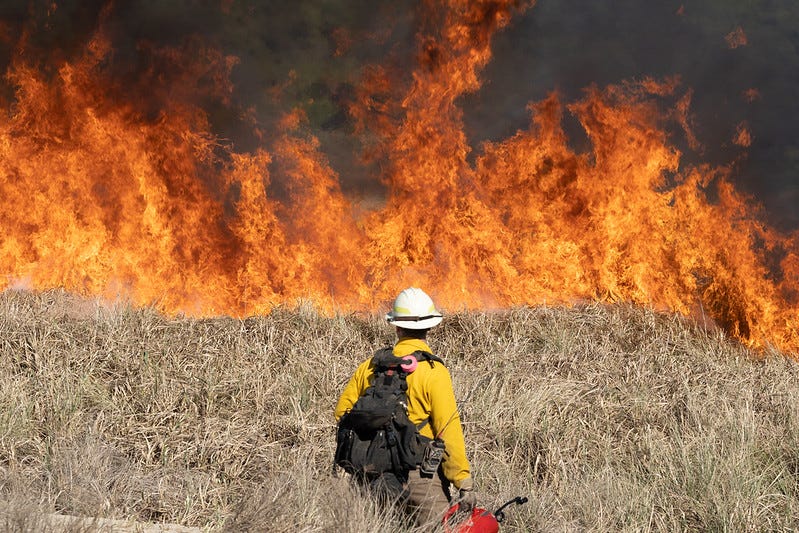
Wildfire experts across the West are sounding the alarm bell about the upcoming summer wildfire season. Data released June 1 by the National Interagency Fire Center revealed that 2.4 million acres have burned across the country so far this year, which is nearly double the ten-year average. According to the latest NIFC forecasts, low winter snowpack levels, ongoing drought, record-breaking spring temperatures, and other factors will contribute to above-normal potential for significant wildfire risk in 2026. This heightened risk applies to many areas of the country through September, including in parts of the Pacific Northwest, Colorado’s Front Range and Western Slope, the Gulf Coast, and other areas of the Great Basin and Southwest.
Recent policy decisions in Washington, D.C. are also likely to have a significant impact on the 2026 wildfire year. In particular, massive staff layoffs, budget cuts, below-average levels of hazardous fuels reduction, and low morale are likely to constrain the capacity of federal agencies to manage heightened wildfire risks in the months ahead.
The Center for Western Priorities hosted a press call on Tuesday, June 2 with wildland fire experts to discuss how the Trump administration’s actions of the previous year are impacting wildfire preparedness and response heading into summer wildfire season.
Here are some of the key policy, resource, and budget changes that will factor into the 2026 Western wildfire season with excerpts from the press call that are lightly edited for clarity.
Staff cuts
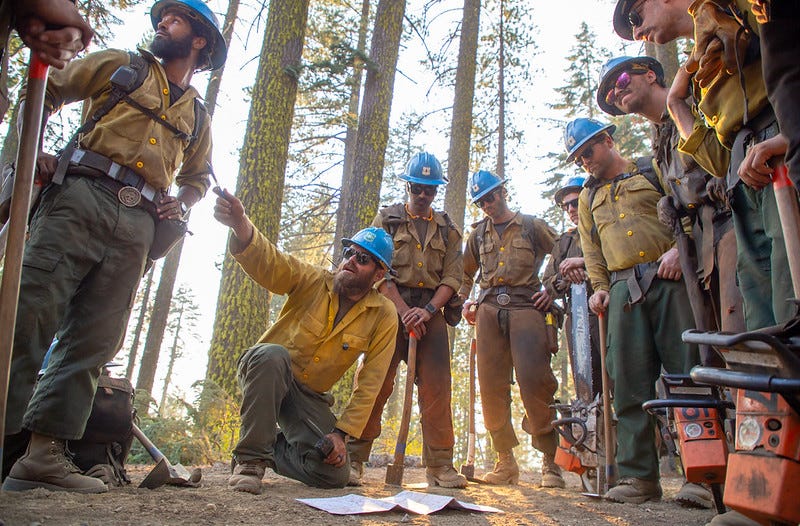
The U.S. Forest Service, National Park Service, Bureau of Land Management, and other federal agencies that fight wildfires lost more than 26,000 rangers and staff since DOGE began laying off employees in early 2025, a 17% nationwide reduction.
The biggest cuts were to staff in rural areas and among newer employees with less than five years of experience. In some Western states, federal agencies lost more than 30 percent of junior staff—the core of the workforce that is typically on the front lines of wildfire response.
Agencies lost staff capacity in nearly every job type, from forecasters and meteorologists to emergency dispatchers.
“The question is whether the agencies and bureaus responsible for risk mitigation, wildfire response, whether they have the workforce in place to be doing the work,” said Andrea Delgado, former deputy regional forester with the U.S. Forest Service and supervisor of Safety, Fire, Fuels and Aviation Management for the Rocky Mountain Region. Delgado noted that communities across 11 Western states bear a disproportionate share of staffing cuts—about 36 percent of the 26,000 jobs cut from the USFS, NPS, and BLM.
Bobbie Scopa, vice president of Grassroots Wildland Firefighters and a former assistant regional fire director in the Northwest for the U.S. Forest Service, made the point that “There is a whole lot more going on behind the scenes other than the helicopters in the air and the hotshots cutting line.” Scopa mentioned the role of Incident Management teams that are formed if a fire is not contained within the first 48 hours after ignition. Scopa described the interagency and interdisciplinary expertise encompassed within an incident management team, saying, “They come from all parts of the land management agencies, and they work on these large fires. They manage the logistics, making sure the food is showing up. They manage the maps, making sure the maps are accurate and drawn, and the financial records that are managed.”
Delgado also underscored the essential collaboration that goes into wildfire response and management. “We’re talking about park rangers, hydrologists, entomologists, fish and wildlife biologists, engineers, and dispatchers, experts who help land managers make data-informed and science-based decisions,” Delgado said.
Less thinning and prescribed burns
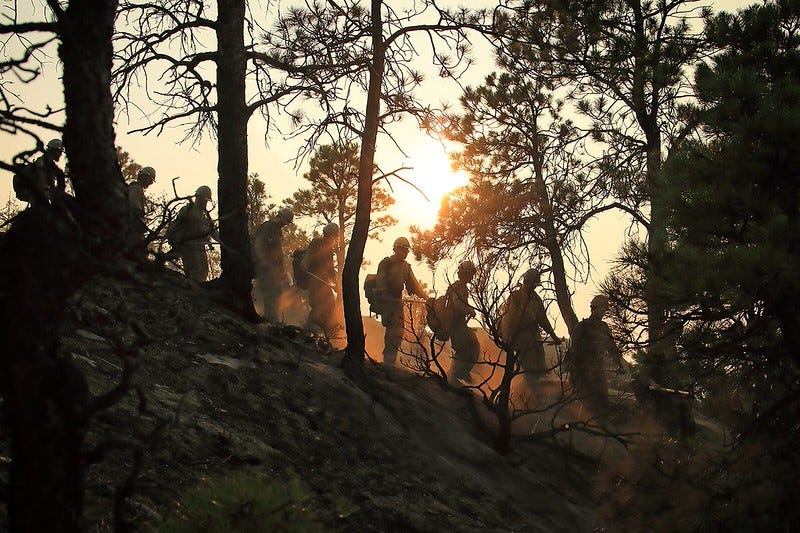
Prescribed burning, thinning, and other wildfire prevention work in federally-managed forests and grasslands fell 35 percent in the Trump administration’s first year in office.
According to a Center for Western Priorities analysis of publicly available USFS data, the Forest Service treated approximately 1.4 million fewer acres in 2025 compared to 2024, leaving an area more than five times the size of Rocky Mountain National Park at higher risk of catastrophic fire.
In December 2025, more than 160 local elected officials in the West sounded the alarm about cuts to federal wildfire resources and a slowdown in federal wildfire preparedness work, and requested that Western state attorneys general review the legality of the administration’s actions.
Delgado highlighted the important role of maintaining strategic fuels reduction work as part of wildfire response and mitigation efforts. “Before an ignition occurs on public lands, the work of reducing wildfire risk on national forests and grasslands must be ongoing,” she said. Delgado referenced the analysis showing that fuels management efforts fell by 35 percent in 2025 compared to 2024, and the type of activities that have decreased. “We’re talking about thinning, prescribed burning, and other wildfire mitigation work in national forests and grasslands.” In Delgado’s words, “This is the crucial work that creates the defensible space. It’s what gives our wildland firefighters access and a fighting chance, and can reduce the loss of life, property, and natural resources when wildfires do occur.”
Dr. Hugh Safford with the University of California-Davis Department of Environmental Science and Policy and a former regional ecologist for the Pacific Southwest Region of the U.S. Forest Service noted there are very few firefighting units with dedicated prescribed fire crews to do that work. “It’s almost all getting done by people on the suppression staff. It’s a little bit like Amtrak using the freight train tracks,” Safford said.
Every state affected
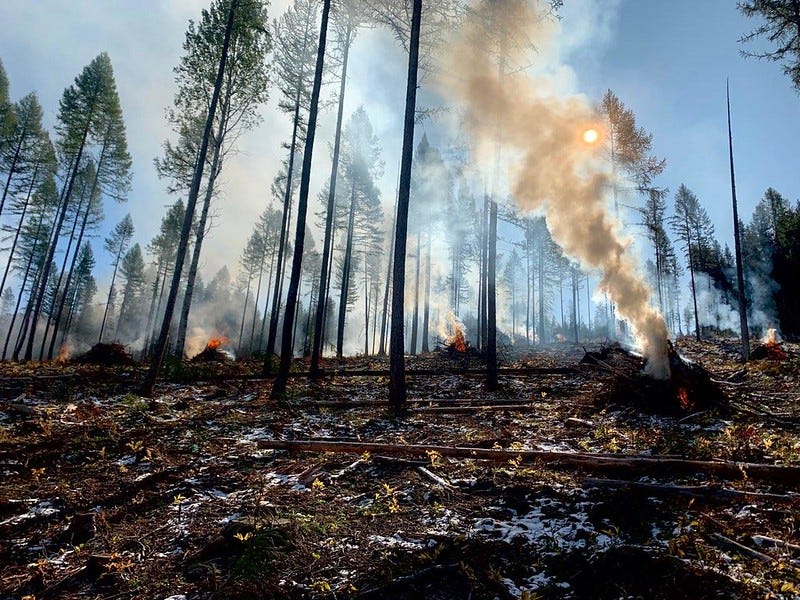
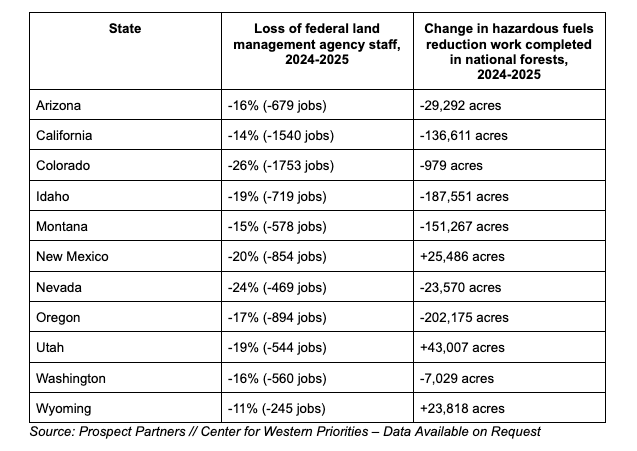
Every state experienced substantial reductions in federal land management agency staff and in the amount of wildfire mitigation work completed on national forests in 2025. Across the Western U.S., hazardous fuels reduction work happened on 646,000 fewer acres in 2025 than 2024.
Dr. Safford expressed concern about budget and staffing cuts across the country. “These cuts exacerbate already-strained capacities and budgets. They threaten the agency’s continued ability to foster ecosystem health and sustainability. And they undermine an already weak foundation in post-fire recovery and restoration, in both the ecological and the socioeconomic senses.”
Dr. Safford also noted the exponential growth over time of the portion of the total Forest Service budget allocation that is dedicated to wildfire. Wildfire-related budget items have grown from 16 percent of the total U.S. Forest Service budget in 1995 to 67 percent of the budget in 2025. “This leaves precious little funding for all the other things a resource management agency should be doing, like building and maintaining trails and campgrounds, protecting watersheds and securing water supplies, protecting endangered species and habitats, carrying out regular inventory and monitoring, sustainably managing forest shrublands and rangelands, planting trees, educating the public,” Safford said.
Bureaucratic chaos
In a period in which federal wildland firefighters should be focused on preparing for wildfire season, the administration is instead putting them through a tumultuous and chaotic reorganization.
At the end of March 2026, on the cusp of the typical start of wildfire season, Secretary of Agriculture Brooke Rollins announced that the U.S. Forest Service would be closing 41 research stations, including several that study wildfire, and moving the headquarters of the Forest Service from Washington, D.C. to Utah. The reorganization has been criticized for being poorly conceived.
Firefighting experts have also raised concerns about the loss of other staff within USDA and DOI, such as contracting officers, who perform functions that are necessary to support wildfire preparedness.
In January 2026, Secretary of the Interior Doug Burgum announced he was moving wildland fire staff out of NPS, BLM, and other federal agencies and forming, without congressional approval or public input, a new and untested government wildfire bureaucracy within the Interior department.
Jeff Mow, vice chair of the Coalition to Protect America’s National Parks and a former superintendent of Glacier National Park, spoke to the complexity of managing wildfires on the ground under “normal” circumstances without an added layer of bureaucratic chaos. “This last year has just had so much chaos, uncertainty, and a lack of transparency in many respects. That has made the predictability and readiness very challenging for folks that are working in these agencies,” said Mow.
Mow was an agency administrator for the incident management teams that came to Glacier National Park, where he noted, “We could have 30,000 visitors a day coming through the park” on a busy summer day. “When a fire occurs, there’s so much that has to go into motion, not only addressing the fire, [but also] evacuating people, ensuring the area’s safe, working with local communities,” he said. Mow emphasized the importance of having a local team that understands the complexities on the ground and is knowledgeable about the local community who will be most impacted by a wildfire, including in-holders that own property in the park.
Low morale
Amid layoffs, budget cuts, and agency reorganizations, staff morale has plummeted.
Roughly half of USFS, BLM, and NPS employees believe their agency’s performance got worse since the previous year. Less than one-fourth of USFS employees currently say they are satisfied with what’s happening in their agency.
Wildland fire experts have noted that although the workforce reductions may not have been intended to directly target wildland firefighters, widespread resignations, losses through the deferred resignation program, and early retirements have functionally dismantled the broader support system that wildland firefighters depend on, and morale is sinking with it.
As a former national park superintendent, Mow responded to concerns regarding low morale within land management agencies. “I think it’s really gotten much worse in the last few months with the administration proposing spending millions on water fountains, golf courses, amenity projects in DC,” Mow said.
As anyone living in the Western United States knows, weather conditions can change dramatically from one moment to the next, which could either exacerbate or abate wildfire risk in the coming weeks and months. Preparing for and responding to wildfires requires consistent and sustained evaluation of the conditions on the ground across the country. This reality underscores the importance of both scientific research and monitoring to predict wildfire potential and manage risk. One thing is clear heading into this summer wildfire season: creating chaos and undermining preparedness benefits no one and puts lives and communities at risk, as the wildfire experts who joined the press call warned.
As CWP Executive Director Aaron Weiss prefaced at the start of the press call, “These problems raise all sorts of questions that Forest Service Chief Tom Schultz will likely be asked about when he testifies before the House Natural Resources Federal Land Subcommittee on Thursday.” During the hearing, Schultz defended the Trump administration’s unpopular staffing cuts to the Forest Service that have contributed to a massive gap in wildfire prevention work heading into the summer wildfire season, as well as the administration’s move to shutter research stations across the U.S. Schultz also defended the administration’s efforts to aggressively ramp up logging in national forests and repeal the Roadless Rule, which currently protects 45 million acres of national forest land from clear-cutting, road-building, mining, and oil and gas drilling. Finally, Schultz defended the administration’s aggressive strategy of putting all wildfires out as soon as possible after they begin, an approach known as full or total suppression that has been shown by science to increase long-term wildfire risk.
While the Trump administration continues to treat our national forests like assets on a balance sheet, prioritizing timber industry profits over responsible, science-backed management, fire managers are faced with a daunting task of keeping our communities safe with fewer personnel and resources and a bleak fire potential outlook.
For more information, visit westernpriorities.org. Sign up for Look West to get daily public lands news sent to your inbox, or subscribe to our podcast, The Landscape.
These actions by the Administration are intended to destroy our National/Public lands in order to make them a “ Commodity”! Destruction by fire will enable a faster land grab for Oil, Gas, & mining! They only see the $$$$ signs & no value in Public lands or National/ state park lands! It’s all planned to take control & profiteer & the people do not count. While having briefings saying “look how much monies we produced & we’re lowering the price of gas & so forth”! We did NOT VOTE FOR THIS!!